EAST3 JOINT SPACE PROGRAM TREATY (EJSP)
CLASSIFIED SCIENTIFIC MEMORANDUM
CLASSIFICATION: TOP SECRET — EAST3 EYES ONLY
SUBJECT: Current Orbital Assets, Space Transportation Infrastructure, Defensive Systems, and Future Joint Space Program Development
ISSUING AUTHORITY: EJSP Joint Scientific and Technical Directorate
DISTRIBUTION: Authorized EAST3 Governments, Joint Space Operations Command, Orbital Infrastructure Directorate, and Designated Scientific Authorities
STATUS: Active Program Review
REPORTING PERIOD: February 2143
—
I. EXECUTIVE SUMMARY
The EAST3 Joint Space Program (EJSP) has entered a new phase of sustained orbital operations, interplanetary logistics, and strategic infrastructure development. The program’s current inventory includes semi-autonomous orbital defense fighters, an operational autonomous interplanetary transport vessel, and the developing infrastructure required to establish routine movement between Earth orbit, lunar orbit, and higher orbital destinations.
The principal objective of the present development cycle is to transition EJSP from a collection of independent spaceflight capabilities into an integrated transportation, scientific, industrial, and defensive network.
Three major priorities define the current program:
Orbital Security: Maintain defensive coverage around the Manned Orbital Laboratory (MOL) and develop the ability to investigate and respond to unidentified spacecraft or other potential external threats.
Space Transportation: Establish dependable transfer capabilities between the MOL, lunar orbit, and future orbital infrastructure through the construction of the Model 1 Orbital Transfer Vehicle (OTV) and Oordra Manned Transfer Station.
Interplanetary Logistics: Expand upon the successful Mars mission of the ESS Shao Lei, including autonomous cargo deployment, interplanetary transit, and long-duration spacecraft maintenance.
The program’s longer-term objective is to support sustained human and robotic activity beyond low Earth orbit, with the L-5 trailing Lagrange-point space-processing station serving as a prospective industrial and logistical hub.
The Joint Scientific and Technical Directorate assesses that the immediate challenge is no longer limited to reaching distant destinations. It is the establishment of reliable transportation, maintenance, resupply, and defensive capabilities capable of supporting continuous operations across multiple orbital environments.
All defensive requirements concerning unidentified extraterrestrial intruders remain precautionary planning assumptions. No confirmed extraterrestrial hostile presence is established by this memorandum.
—
II. MARS-CLASS ORBITAL DEFENSE FIGHTER
Program designation: Mars Class
Classification: Semi-Autonomous Orbital Defense Craft
Country of origin: EAST3 Joint Space Program
Operational inventory: 6
Primary operating area: Near the Manned Orbital Laboratory
Crew configuration: Two personnel or unmanned operation
A. Mission and Operational Purpose
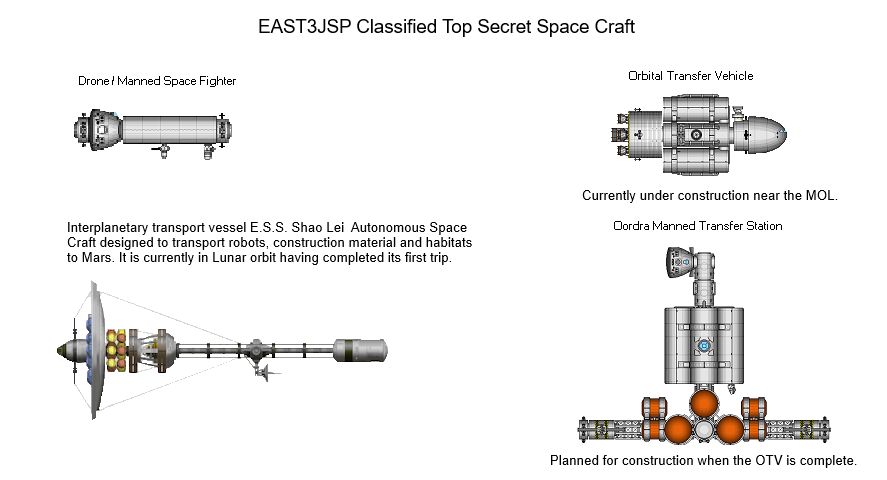
The EJSP currently maintains six Mars-class fighters in near orbit of the Manned Orbital Laboratory. These spacecraft constitute the program’s dedicated orbital defense element and provide a security capability intended to protect critical infrastructure against unidentified spacecraft and other potential threats.
The Mars-class platform was developed around a dual operating concept: semi-autonomous operation under centralized mission control, with provision for a two-person crew when direct human supervision or onboard intervention is required.
The unmanned configuration allows the craft to remain available for routine patrol, observation, and defensive readiness without requiring a permanent crew. The manned configuration provides an additional means of evaluating unexpected situations in which direct human judgment may be considered necessary.
The program’s stated strategic requirement includes the possibility of encountering unidentified intruders originating beyond the Solar System. This requirement should be understood as a precautionary defense scenario rather than evidence that such intruders have been detected.
B. Technical Specifications
| Characteristic | Specification |
|---|
| Designation | Mars Class |
| Vehicle type | Orbital fighter |
| Mass | 19 metric tons |
| Crew | Two or unmanned |
| Maneuvering propulsion | Apollo RD-4D maneuvering thrusters |
| Primary propulsion | Lithium-fed magnetoplasmadynamic (MPD) ion thrusters |
| Armament | Four anti-ship missiles or anti-fighter bus |
| Secondary weapon | Neutron 4 mm rail gun |
| Countermeasures | Flares, decoys, electronic countermeasures |
| Structural protection | Whipple armor |
| Escape system | Cockpit escape pod |
| Inventory | Six spacecraft |
C. Propulsion and Maneuverability
The Mars class combines Apollo RD-4D maneuvering thrusters with lithium-fed magnetoplasmadynamic ion propulsion. The configuration separates immediate attitude and maneuvering requirements from longer-duration propulsion requirements.
The RD-4D system supports spacecraft positioning and maneuvering, while the MPD ion propulsion system provides the principal means of sustained thrust during appropriate mission phases. The combined architecture is intended to support station-keeping, repositioning, and extended orbital operations.
Actual maneuvering performance, propellant reserves, acceleration limits, and endurance remain dependent on the final verified performance characteristics of the propulsion systems.
D. Defensive Architecture
Mars-class defensive provisions include electronic countermeasures, decoys, flares, and Whipple armor. Together, these systems are intended to improve survivability against selected external hazards and potential hostile actions.
Whipple armor provides protection against certain high-velocity debris impacts by disrupting and dispersing incoming material before it reaches the protected spacecraft structure. Electronic countermeasures and decoys serve different functions and should not be assumed to provide protection against every possible detection or targeting system.
The cockpit escape pod provides an emergency crew-survival provision for the manned configuration.
E. Scientific and Strategic Assessment
The Mars class represents EJSP’s initial dedicated orbital security capability. Its most important contribution is the establishment of a permanent defensive asset category around the MOL.
The small inventory of six spacecraft, however, requires careful management of maintenance cycles, crew availability, propellant reserves, and operational readiness. The distinction between the manned and unmanned configurations also introduces different requirements for life support, onboard systems, and mission supervision.
Directorate assessment: The Mars-class fleet should be considered a limited orbital defense capability rather than a guarantee of protection against unknown threats. Its effectiveness depends on detection, identification, communications, and the reliability of supporting orbital infrastructure.
—
III. MODEL 1 ORBITAL TRANSFER VEHICLE
Program designation: Model 1
Classification: Orbital Logistics and Transfer Vehicle
Country of origin: EAST3 Joint Space Program
Construction status: Under construction near the MOL
Operational inventory: None
Projected crew: Two
Design mass: 800 metric tons
A. Program Overview
The Model 1 Orbital Transfer Vehicle is currently under construction in the vicinity of the Manned Orbital Laboratory. It is intended to provide a reusable transportation capability between the MOL, higher orbital destinations, and lunar orbit.
The vehicle represents a major step in the development of routine space transportation. Existing launch vehicles can deliver personnel, equipment, and supplies into space, but a sustainable orbital network requires a means of moving those resources between destinations after their initial launch.
The Model 1 is intended to fulfill that requirement.
Two additional rocket launches from the Macclesfield Bank Launch Facility are required to deliver the remaining supplies identified in the current construction plan. Completion of these deliveries remains a prerequisite for advancing the vehicle toward its intended operational role.
B. Technical Specifications
| Characteristic | Specification |
|---|
| Designation | Model 1 |
| Vehicle type | Orbital transfer vehicle |
| Country of origin | EJSP |
| Design mass | 800 metric tons |
| Maneuvering propulsion | Apollo RD-4D maneuvering thrusters |
| Primary propulsion | Lithium-fed MPD ion thrusters |
| Crew | Two |
| Defensive armament | KKW close-in weapon system (CIWS) |
| Countermeasures | Flares, decoys, electronic countermeasures |
| Structural protection | Whipple armor |
| Operational inventory | Zero |
C. Intended Mission Profile
Upon completion, the Model 1 is expected to support routine transfers from the MOL to higher orbits and lunar orbit. Its intended duties include transporting personnel, moving equipment, delivering cargo, and supporting the assembly and maintenance of future orbital facilities.
The vehicle’s development is directly linked to the planned Oordra Manned Transfer Station and the broader logistics network connecting Earth orbit with the L-5 trailing Lagrange-point space-processing station.
By separating transportation between orbital destinations from the initial launch from Earth, EJSP intends to reduce dependence on direct-launch missions for every movement of cargo and personnel.
D. Defensive Provisions
The Model 1 design incorporates a KKW close-in weapon system, electronic countermeasures, decoys, flares, and Whipple armor.
These provisions indicate that the vehicle has been designed to operate within an orbital environment where protection of high-value transportation assets is a program consideration. They do not, by themselves, establish the vehicle’s readiness for combat or prove that it can safely operate in every threatened environment.
As the Model 1 has not yet entered service, its actual operational capabilities remain unverified.
E. Development Priorities
The principal milestones remaining for the Model 1 are:
Completion of the outstanding supply deliveries from Macclesfield Bank.
Completion and inspection of vehicle assembly.
Verification of propulsion, power, guidance, and communications systems.
Validation of the intended transportation and docking functions.
Establishment of maintenance, crew qualification, and operational procedures.
Directorate assessment: The Model 1 is a foundational logistics project. Its successful completion would give EJSP an important new means of moving supplies and equipment between established orbital destinations, but construction status must not be confused with operational readiness.
—
IV. ESS SHAO LEI — AUTONOMOUS INTERPLANETARY TRANSPORT
Vessel designation: ESS Shao Lei
Classification: Autonomous interplanetary transport
Country of origin: EAST3 Joint Space Program
Operational inventory: One
Design mass: 1,100 metric tons
Crew: Autonomous
Current location: Lunar orbit
Current status: Routine maintenance following a completed Mars mission
A. Mission History
The ESS Shao Lei has completed a mission to Mars, entered Martian orbit, deployed cargo pods, and subsequently returned to the Earth-Moon region. The vessel is currently in lunar orbit undergoing routine maintenance.
The mission represents an important milestone for EJSP. It demonstrates the program’s stated ability to conduct an autonomous interplanetary transport mission involving departure, interplanetary transit, orbital operations, cargo deployment, and return.
The successful completion of these mission phases provides a foundation for future logistics operations beyond Earth orbit.
The vessel’s current maintenance period is intended to support the continued reliability of its systems following the completed mission. Further operational assignments will depend on inspections, servicing requirements, and confirmation that the vessel is ready for another flight.
B. Technical Specifications
| Characteristic | Specification |
|---|
| Name | ESS Shao Lei |
| Type | Autonomous transport |
| Country of origin | EJSP |
| Mass | 1,100 metric tons |
| Maneuvering propulsion | Apollo RD-4D maneuvering thrusters |
| Primary propulsion | Lithium-fed MPD ion thrusters |
| Power source | PB reactor |
| Crew | Autonomous |
| Armament | Eight anti-ship missiles |
| Close-in defense | Two KKW CIWS |
| Countermeasures | Flares, chaff, electronic countermeasures |
| Structural protection | Whipple armor |
| Cargo capacity | Eight cargo modules |
| Number in service | One |
C. Propulsion and Power Systems
The ESS Shao Lei combines maneuvering thrusters, lithium-fed MPD ion propulsion, and a PB reactor. This architecture is intended to support an autonomous spacecraft with substantial power requirements and an extended operating profile.
The reactor provides the vessel’s onboard power source, while the propulsion systems perform their respective maneuvering and transit functions. The vessel’s ability to conduct extended missions depends on the reliability of these systems, the availability of consumables and replacement components, and the performance of its autonomous control architecture.
The present maintenance period provides an opportunity to evaluate system performance following the Mars deployment and return.
D. Cargo and Logistics Role
The vessel can carry eight cargo modules, making it a major component of EJSP’s planned interplanetary transportation network.
Cargo pods deployed during the Mars mission provide the program with a means of separating delivered payloads from the transport vessel itself. The long-term value of this capability lies in the potential to support repeated cargo deliveries without requiring every mission to be designed around a single indivisible payload.
Future mission planning should establish whether the cargo modules are standardized, reusable, independently powered, or intended for specific classes of payload. These details will affect how effectively the vessel can support a larger transportation network.
E. Strategic Significance
The ESS Shao Lei is currently the most mature interplanetary transport asset described in the EJSP inventory.
Unlike the Model 1, which remains under construction, the Shao Lei has completed a reported Mars mission and is undergoing maintenance in lunar orbit. Its experience should therefore inform the development of future transport vehicles, mission-control procedures, cargo interfaces, and long-duration autonomous operations.
Directorate assessment: The vessel’s primary strategic value is logistical rather than purely military. Its continued availability would provide EJSP with a reusable platform for interplanetary cargo transport and a practical foundation for future missions beyond the Earth-Moon system.
—
V. OORDRA MANNED TRANSFER STATION
Program designation: Oordra
Classification: Manned orbital transfer and logistics station
Development status: Planned infrastructure
Primary mission: Transfer and distribution of personnel, equipment, and supplies
A. Concept of Operations
The Oordra Manned Transfer Station is planned as an intermediate logistics node connecting Earth orbit, lunar orbit, and the L-5 trailing Lagrange-point space-processing station.
Under the proposed operating concept, supplies delivered from the L-5 facility would be transferred to Oordra for subsequent distribution to the Model 1 OTV and ESS Shao Lei. The station would provide a common point at which cargo could be received, inspected, stored, and reassigned to appropriate transport vehicles.
The objective is to reduce the need for direct transportation between every facility in the EJSP network.
Instead of requiring each spacecraft to service every destination independently, Oordra would serve as an interchange point linking different transportation routes and mission types.
B. Intended Functions
The proposed station is expected to support:
Receipt and transfer of cargo arriving from L-5.
Temporary storage and inventory management.
Distribution of supplies to the OTV and ESS Shao Lei.
Transfer of personnel between designated spacecraft.
Routine inspection and servicing of compatible cargo systems.
Coordination of transport schedules and mission requirements.
The precise capacity, crew complement, power architecture, life-support requirements, and construction schedule remain to be established in the detailed station design.
C. Role in the EJSP Network
Oordra is intended to connect the program’s transportation and industrial elements into a single logistics architecture.
The Model 1 would provide movement between orbital destinations. The ESS Shao Lei would support interplanetary transport. The L-5 facility would serve as a prospective source of processed materials and supplies. Oordra would coordinate the transfer of those resources between transport systems.
The station’s value would consequently extend beyond its own physical structure. Its success would depend on compatible docking interfaces, standardized cargo handling, reliable communications, and a sustainable supply schedule.
Directorate assessment: Oordra is a key enabling project, but its intended role depends on the successful development of the transportation vehicles and L-5 infrastructure it is designed to connect.
—
VI. KIRKLIN KINETIC KILL WEAPONS
System designation: Kirklin Mines
Classification: Kinetic interception and defensive denial system
Intended role: Defense against potentially hostile spacecraft
A. System Overview
The Kirklin system consists of kinetic kill weapons intended to maneuver into the flight path of a spacecraft as a defensive measure.
Unlike conventional weapons that rely on an explosive warhead, a kinetic interception system seeks to use the collision itself to disable or destroy its target. The system’s defining characteristic is therefore its reliance on relative motion and physical impact.
Within the EJSP framework, Kirklin Mines are designated as a defensive capability for scenarios in which the movement of a potentially hostile spacecraft presents a direct threat to protected orbital assets.
B. Strategic and Scientific Considerations
The deployment of kinetic interception systems in space presents substantial technical and operational risks.
Objects placed in orbital trajectories may remain hazardous after their original mission has ended. A failed interception can produce debris, while a successful interception can also generate fragments that threaten other spacecraft and orbital infrastructure.
The risks are particularly significant around the MOL and any future transportation or transfer stations, where a single debris-generating incident could affect multiple assets.
For this reason, the existence of a defensive system should not be interpreted as unrestricted authorization to employ it. Identification, command authorization, risk assessment, and consideration of nearby spacecraft remain important elements of any defensive policy.
The available program description does not establish the number of Kirklin Mines in service, their current deployment locations, or their demonstrated performance.
Directorate assessment: Kirklin Mines represent a potentially consequential component of EJSP’s orbital defense architecture. Their strategic utility must be assessed alongside the long-term risks associated with debris generation and interference with civilian, scientific, and commercial operations.
—
VII. INTEGRATED EJSP INFRASTRUCTURE
The projects described above are not independent acquisitions. They form parts of a larger effort to establish an interconnected orbital and interplanetary network.
The proposed architecture assigns each major system a distinct function:
| Asset | Principal function | Current status |
|---|
| Mars-class fighters | Orbital security and defensive patrol | Six in service |
| Model 1 OTV | Transfer between orbital destinations | Under construction |
| ESS Shao Lei | Autonomous interplanetary cargo transport | Operational; in lunar-orbit maintenance |
| Oordra station | Cargo interchange and manned transfer | Planned |
| L-5 processing station | Orbital processing and supply support | AI-operated facility |
| Kirklin Mines | Kinetic defensive interception | Inventory and deployment status unspecified |
| Manned Orbital Laboratory | Human orbital operations and scientific research | Existing program facility |
The long-term objective is to establish a network in which transportation, industrial processing, scientific research, and security functions reinforce one another.
Such a network would provide greater operational flexibility than a collection of spacecraft dependent on independent launch and mission arrangements. However, the benefits depend on interoperability, standardized systems, reliable power and communications, and the ability to sustain operations over extended periods.
—
VIII. FUTURE PROGRAM DEVELOPMENT
The following priorities are proposed for consideration by the EAST3 Joint Scientific and Technical Directorate. They represent prospective development goals, not confirmation that all projects have been approved or funded.
Priority One — Complete the Orbital Transfer Vehicle
Completion of the Model 1 should remain a major near-term objective. The outstanding supply deliveries and subsequent system verification are necessary before the vehicle can be considered operational.
Successful commissioning would expand the program’s ability to move cargo and equipment between established orbital destinations.
Priority Two — Establish Oordra as a Logistics Hub
Oordra should be developed in coordination with the OTV and ESS Shao Lei programs. Common cargo standards and compatible interfaces would reduce the risk of constructing a station that cannot efficiently support the vehicles intended to use it.
Planning should also establish the station’s life-support requirements, crew capacity, maintenance arrangements, and emergency provisions.
Priority Three — Sustain Autonomous Interplanetary Operations
The ESS Shao Lei mission should be used to inform future autonomous transport missions. Post-flight evaluation should document system reliability, maintenance requirements, cargo deployment performance, and any operational limitations identified during the Mars mission.
These findings would help determine the conditions under which additional autonomous transport vehicles could be justified.
Priority Four — Expand Scientific and Industrial Support
The L-5 space-processing station represents a potential means of supporting future orbital construction and resource management.
Further development should establish the materials it can process, the level of autonomy it can safely sustain, its expected production capacity, and the reliability of transferring its output through Oordra to other destinations.
Priority Five — Improve Orbital Safety and Identification
The presence of dedicated orbital defense craft and proposed kinetic interception systems makes reliable identification and tracking an important program requirement.
EJSP should distinguish confirmed objects and verified threats from unidentified observations or speculative scenarios. This is particularly important when a mistaken assessment could lead to an unnecessary interception or the creation of hazardous debris.
Priority Six — Establish Long-Term Maintenance and Readiness Standards
As the number of interconnected facilities grows, EJSP will require common procedures for maintenance scheduling, component replacement, system certification, and readiness reporting.
The program’s future sustainability will depend not only on the performance of individual spacecraft but also on the reliability of the entire network.
—
IX. SCIENTIFIC LIMITATIONS AND ITEMS REQUIRING VERIFICATION
The Directorate should maintain a clear distinction between declared specifications, demonstrated performance, and future objectives.
The current information identifies several matters requiring additional technical documentation:
Verified propulsion performance and endurance for the Apollo RD-4D and lithium-fed MPD systems.
The exact meaning and technical configuration of the anti-fighter bus listed among Mars-class armament options.
The capabilities and operational limitations of the KKW close-in weapon systems.
The power output, safety arrangements, and maintenance requirements of the PB reactor aboard the ESS Shao Lei.
The precise construction and commissioning schedule for the Model 1 OTV.
The design specifications, staffing requirements, and cargo capacity of Oordra.
The inventory, deployment status, and safety controls applicable to Kirklin Mines.
The demonstrated production capabilities of the L-5 space-processing station.
These gaps do not invalidate the program’s stated objectives. They indicate where additional documentation is necessary to establish technical readiness and support reliable planning.
In particular, the existence of a declared weapon system does not independently establish its operational effectiveness, and a completed mission does not establish that every component of a spacecraft has been validated for repeated service.
—
X. FINAL ASSESSMENT
The EAST3 Joint Space Program is moving toward a more integrated model of space operations, combining orbital defense, autonomous interplanetary transportation, planned crewed transfer infrastructure, and prospective orbital industrial capacity.
The six Mars-class fighters provide an existing orbital security capability. The ESS Shao Lei has completed a reported Mars transport mission and is undergoing maintenance in lunar orbit. The Model 1 OTV remains under construction, while Oordra is intended to provide the logistics infrastructure necessary to connect orbital destinations and transport vehicles.
The L-5 processing station represents a further step toward a network capable of supporting sustained activity beyond Earth orbit. Kirklin Mines form part of the program’s stated defensive planning, although their operational status and performance require further documentation.
The immediate challenge is to convert these individual capabilities into a reliable, maintainable, and interoperable system.
The next phase of EJSP development should therefore prioritize verified technical performance, transportation reliability, standardized logistics, and orbital safety. These foundations will determine whether the program can progress from successful individual missions toward routine, sustained operations across the Earth-Moon system and beyond.
FINAL DIRECTORATE FINDING:
The EJSP possesses an established foundation for orbital operations and autonomous interplanetary logistics. Its next major milestone is the integration of transportation, industrial support, and orbital infrastructure into a sustainable network. Further expansion should be guided by demonstrated capability, documented readiness, and coordinated planning among the participating EAST3 governments.
END OF MEMORANDUM
EJSP JOINT SCIENTIFIC AND TECHNICAL DIRECTORATE
TOP SECRET — EAST3 EYES ONLY
UNAUTHORIZED DISTRIBUTION PROHIBITED


