MERIDIAN GLOBAL NETWORK
MGN | NATIONAL POLITICS • ECONOMY • SECURITY
GUANGZHOU REACTS TO SWEEPING NATIONAL RESILIENCE ACT AS CORPORATE ALLIANCE PREPARES FOR VOTE
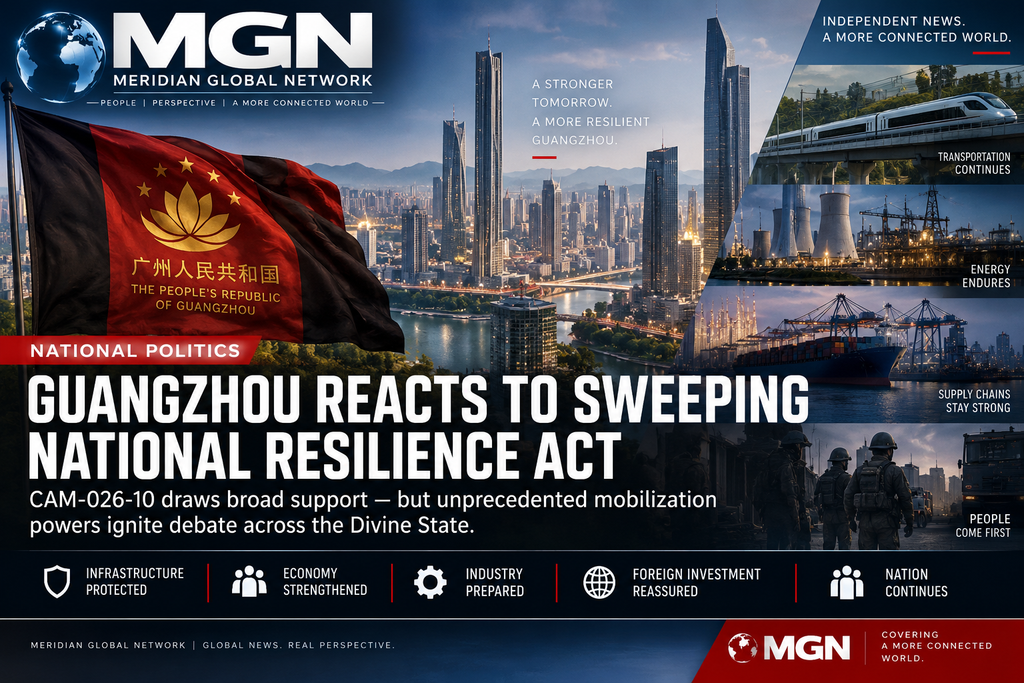
CAM-026-10 draws broad support for infrastructure protections and foreign-investment guarantees — but unprecedented domestic mobilization and corporate intervention powers ignite debate over just how much authority Guangzhou should prepare before the next crisis.
NEW GUANGZHOU PRIME — A sweeping proposal from Corporate Alliance Chair Darius Vhal and Minister of Sovereign Defense Carmilla Sinclair has rapidly become one of the most closely watched pieces of legislation of the new administration.
The National Strategic Resilience & Continuity Act — CAM-026-10 remains before the Corporate Alliance awaiting a vote. Officially, its purpose is straightforward: ensure Guangzhou can continue operating through cyberattacks, infrastructure failures, natural disasters, military emergencies and other national disruptions.
But as the public, corporations and foreign investors digest the enormous proposal, attention has increasingly shifted from what the Act would protect to what it would allow Guangzhou to do during a national emergency.
And public reaction has been intense.
—
“WE SHOULD HAVE DONE THIS YEARS AGO.”
Much of the initial reaction across Guangzhou has been favorable.
Supporters have pointed to the Act’s requirements for geographically separated backup systems, emergency power, redundant communications and protections against single points of failure as overdue reforms for a country whose enormous population increasingly depends upon highly interconnected infrastructure.
The Continuum Grid provisions have received particularly strong attention.
CAM-026-10 would require PRG Logistics to identify vulnerabilities capable of causing national-scale transportation disruptions while developing alternative routes, regional control capability, emergency freight corridors and replacement-component reserves. Most significantly, the proposal declares that the failure of a single national operations center must never be capable of disabling the entire Continuum Grid.
Similar requirements would apply to Guangzhou’s electrical and communications infrastructure.
For many residents, these are the least controversial portions of the legislation.
One widely repeated sentiment across domestic discussion has been simple:
“If 814 million people depend on these systems, there should always be a second switch.”
—
THE SHADOW OF THE SOUL CRISIS
There is little doubt that CAM-026-10 is also being interpreted through the final turbulent period of the Veneer Soul administration.
Perhaps nowhere is that more apparent than Section VII — Independent Threat Verification.
The legislation would prohibit a single sensor network, corporation, automated system or intelligence source from independently providing sufficient justification for extraordinary nationwide mobilization when sufficient time exists for independent verification.
Future strategic warnings would also have to be classified as CONFIRMED, PROBABLE, UNVERIFIED or CONTRADICTORY before reaching national decision-makers.
That provision has received unusually broad public support.
For critics of the previous administration, it represents perhaps the clearest legislative acknowledgment yet that the panic, contradictory warning information and extraordinary military response of the final Soul period cannot be allowed to happen again.
But Vhal’s solution is not simply to make mobilization harder.
It is also to make Guangzhou far better at it.
—
THE PROVISION EVERYONE IS TALKING ABOUT
Buried deeper within the enormous legislation is what may ultimately become its defining feature:
The National Continuity Capacity Registry.
If approved, Guangzhou would begin identifying domestically controlled factories, transportation fleets, aircraft, ships, construction equipment, communications infrastructure, energy capacity, warehouses, medical infrastructure, engineering resources, data-processing systems and specialized personnel possessing significant value during a national emergency.
None would automatically become government property.
But domestic operators possessing strategically important capabilities could be required to maintain plans allowing those resources to transition into national service.
And that has transformed the public debate.
Supporters describe it as common sense.
Critics describe it as the beginning of a mobilization economy hiding inside an infrastructure bill.
—
THE EMPEROR’S NEW MOBILIZATION AUTHORITY
The strongest compulsory powers would remain beyond Vhal’s unilateral authority.
CAM-026-10 reserves issuance of a National Continuity Mobilization Order to Emperor Tronus.
Such an order could be issued where armed conflict, foreign attack, catastrophic infrastructure failure, widespread natural disaster or another grave event threatens the continued functioning, sovereignty or security of Guangzhou.
Once activated, domestic operators could be directed to prioritize transportation, energy, communications, industrial production, construction, medicine, food distribution, logistics, cybersecurity, infrastructure restoration and national defense. Domestic resources could also be temporarily requisitioned where existing state capabilities proved insufficient.
Industrial facilities could subsequently be ordered to modify or expand production for everything from medical equipment and communications systems to transportation equipment and defense materiel.
That has produced some of the loudest criticism yet.
Opponents argue Guangzhou could theoretically place enormous portions of its domestic economy on a wartime footing following a single Imperial order.
Supporters counter that this is precisely the point—and that a mobilization system invented after an attack begins is hardly a mobilization system at all.
—
THE VHAL CLAUSE?
Another provision is beginning to attract considerably more scrutiny.
Under Section IX-A, the National Security Directorate could issue a Temporary Continuity Directive where the failure, compromise, incapacitation or “non-cooperation” of a domestic critical-infrastructure operator threatens national continuity.
More controversially, where corporate leadership is “unable or unwilling” to execute an approved continuity plan, Chair Darius Vhal could appoint a Temporary National Continuity Administrator to coordinate the affected service.
The legislation explicitly states that this would not constitute nationalization or transfer corporate ownership.
That distinction has not stopped critics from giving the provision an unofficial nickname:
“The Vhal Clause.”
The question being asked throughout New Guangzhou Prime today is increasingly obvious:
Who determines when a corporation is being non-cooperative?
And how much practical difference exists between owning a corporation and temporarily controlling the critical service it operates?
Supporters of the Chair have responded that the government cannot simply stand aside while a corporate dispute allows electricity, transportation, communications or water infrastructure to fail.
The debate is unlikely to disappear before the vote.
—
BUT FOREIGN INVESTORS RECEIVE AN EXTRAORDINARY GUARANTEE
Perhaps surprisingly for legislation containing such extensive domestic mobilization powers, some of the strongest protections in CAM-026-10 belong to foreign businesses and foreign civilians.
The Act explicitly limits its mobilization regime to Guangzhou citizens, Guangzhou-controlled corporations and qualifying domestic assets.
Foreign citizens cannot be compelled into national service.
Foreign companies cannot automatically be entered into Guangzhou’s mobilization registry.
And simply investing, working or residing within Guangzhou would not constitute participation in Guangzhou’s defense establishment.
Foreign-owned factories, aircraft, vessels, warehouses, intellectual property and other assets are further protected from compulsory industrial conversion, defense production and mobilization requisition under CAM-026-10.
Foreign companies could still voluntarily participate—and potentially earn enormous government contracts doing so.
But they could also say no.
The Act explicitly declares that refusal by a foreign corporation to participate cannot be considered “non-cooperation” and cannot be used against its investment status, licensing, residency or ordinary commercial access.
That firewall appears deliberately designed to send a message beyond Guangzhou’s borders:
Guangzhou’s citizens may be obligated to Guangzhou. Foreign investors are not.
—
BUSINESS COMMUNITY: RELIEF AND UNEASE
Reaction within Guangzhou’s domestic corporate sector has been considerably more complicated.
The foreign-investment protections have been broadly welcomed as another indication that the Vhal administration intends to continue opening Guangzhou to international capital.
CAM-026-10 even explicitly encourages foreign companies to compete for civilian resilience contracts without surrendering their exemption from the mobilization system.
Domestic companies face a very different reality.
For them, passage could eventually mean government assessments of production capacity, emergency conversion plans, strategic transportation arrangements and mandatory demonstrations that assigned continuity responsibilities can actually be performed.
And the government would not need to declare a national emergency to begin those preparations.
—
“PREPARATION IS NOT MOBILIZATION.”
That sentence—or some variation of it—may ultimately define the political fight surrounding CAM-026-10.
Section XV explicitly separates mobilization preparation from mobilization execution.
The government would require no Imperial mobilization order to identify eligible domestic resources, maintain the capacity registry, prepare factory-conversion plans, position strategic materials, conduct exercises, establish communications interfaces, prepare transportation priorities or evaluate industrial surge capacity.
All of that would legally constitute ordinary national resilience preparation.
Only actual compulsory conversion, requisition or diversion would require formal activation.
Supporters consider that distinction the legislation’s greatest strength.
Critics consider it the most consequential sentence in the entire Act.
Because if CAM-026-10 passes, Guangzhou would not have to wait for war to determine how its economy could mobilize.
It would already know.
—
A DIFFERENT KIND OF GUANGZHOU
CAM-026-10 is therefore producing a strange political moment for the Vhal administration.
The same government that reopened Guangzhou to the outside world and has sought to move beyond the confrontational atmosphere of the Soul period is now proposing one of the most comprehensive national-continuity frameworks Guangzhou has considered.
But the philosophy is markedly different.
The legislation repeatedly emphasizes maintaining civilian services rather than demonstrating military power. Its annual resilience exercise, for example, would explicitly focus on continuing and restoring essential services rather than displays of military strength.
At the same time, there is little disguising what CAM-026-10 would ultimately create.
A Guangzhou that can lose power stations without losing cities.
Lose communications centers without losing government.
Lose transportation nodes without losing the Continuum Grid.
And, if Emperor Tronus ever determines that national survival requires it:
A Guangzhou capable of turning the immense weight of its domestic economy toward national defense.
The Act’s final declaration perhaps summarizes Vhal’s argument better than anything else contained in its hundreds of provisions:
“Guangzhou shall not measure resilience by whether disruption can always be prevented. It shall measure resilience by whether Guangzhou continues.”
The Corporate Alliance has yet to decide whether that vision will become law.
MGN will continue coverage as CAM-026-10 moves toward a vote.





 Go Commeran. Go Fronteer. United Commonwealth | All rights reserved 2026.